
Disclaimer: I’m sharing this from my own personal experience as an everyday person. If you have specific health conditions or injuries, please consult a qualified healthcare professional.
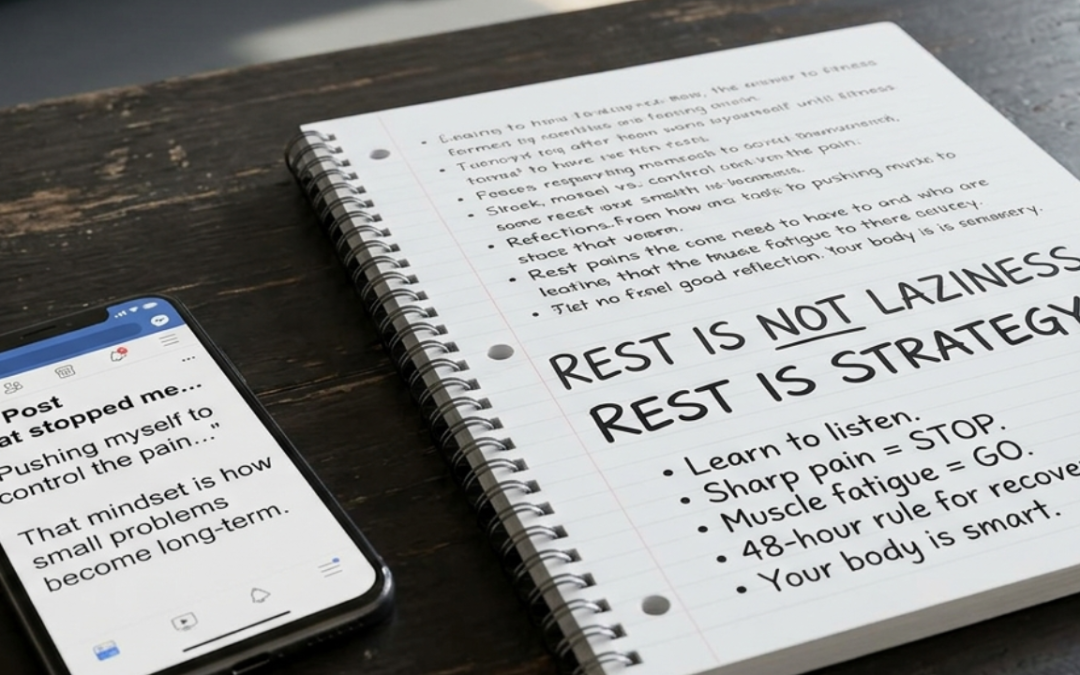
I was scrolling through Facebook recently when a post stopped me in my tracks. The caption read: “Strained my left hip doing deadlifts yesterday. Pushing myself to control the pain rather than let it control me.”
I felt compelled to write this article the moment I read it. Because that mindset, as determined as it sounds, is one of the most common ways people turn a small problem into a long-term one.
So if you have ever been told to push through the pain, or if you have said it to yourself, this one is for you.
Your Body Is Smarter Than You Give It Credit For
I genuinely believe our bodies are incredibly intelligent. The problem is that we have a habit of ignoring what they are trying to tell us.
Think about it. When you have an upset stomach, your body is not punishing you. It is actively working to push something harmful out of your system. The discomfort is not the enemy. It is the signal. The same logic applies to any strain, ache, or sharp pain during exercise. Your body is waving a flag, telling you that a particular area needs attention, relief, or rest.
According to the National Institute of Arthritis and Musculoskeletal and Skin Diseases (NIAMS), chronic injuries typically develop when the same area is repeatedly overloaded without adequate recovery. Ignoring early warning signs is one of the most common pathways from a minor strain to a long-term injury.
“No Pain, No Gain” Has a Limit
The phrase “no pain, no gain” is not entirely wrong, but it is very often misunderstood. There is an important difference between two types of pain that researchers at St Mary’s University have highlighted clearly in their work on exercise-induced pain.
The first type is the natural burning or fatigue you feel during a workout, your muscles working hard and being pushed beyond their usual range. That kind of discomfort is part of the process and is generally non-damaging.
The second type is injury pain, which is sharp, localised, and persists after you stop exercising. A hip strain from deadlifts falls squarely into this second category. That is not a signal to push harder. That is a signal to stop.
Continuing to train on an injured area without rest does not make you tougher. According to Cleveland Clinic, it can cause chronic inflammation, long-term joint damage, and in some cases, conditions like arthritis that stay with you for decades.
Why Rest Is Where the Gains Actually Happen
Here is something that took me a while to fully appreciate: your muscles do not grow during your workout. They grow during rest.
When you train, you create tiny micro-tears in your muscle fibres. It is during the recovery period that your body repairs those tears, and in doing so, builds the muscle back slightly stronger than before. According to the University of Colorado’s sports medicine research, this repair and growth process happens during rest and recovery, not during the exercise session itself.
If you keep training the same muscle group without giving it time to recover, you are essentially tearing the same tissue before it has had a chance to heal. Over time, this leads to overtraining syndrome, characterised by persistent fatigue, declining performance, and a much higher risk of injury.
The 48-Hour Rule I Follow
When I do a full body workout session, I always rest at least 48 hours before training the same muscle groups again. This means I train on alternate days rather than consecutive ones.
Research published in PMC, supported by guidelines from the American College of Sports Medicine, recommends at least 48 to 72 hours of recovery between resistance training sessions targeting the same muscle group. Lower body muscles in particular, such as the glutes, hamstrings, and quads, tend to need closer to 72 hours given the larger muscle mass involved.
There are days when I finish a session feeling like I did not work hard enough on a particular group. My instinct used to be to add extra sets the following day. Now I hold back. Instead of adding volume the next day, I make a mental note to increase the weight in the next proper session. This way, every muscle group gets the recovery it needs, and I come back to each session fresher and ready to progress.
What To Do If Something Does Not Feel Right
If you feel a strain, a sharp pain, or an unusual ache during a session, here is my simple approach:
- Stop the exercise immediately, do not try to finish the set
- Rest that muscle group completely until the pain subsides
- If the pain persists beyond a day or two, or worsens, see a doctor or physiotherapist
- When you return to training, start lighter than before and build back up gradually
- Never use pain as a benchmark for effort. Use your form and your progressive load instead
As Cleveland Clinic advises, most sports injuries can heal well with appropriate rest and care, but any injury that does not resolve on its own deserves professional attention.
The Lazy Fitness Take on Rest
Rest is not laziness. Rest is strategy. The smartest approach to building a stronger, healthier body is to train hard, recover properly, and show up consistently over the long run. One session lost to rest is nothing compared to weeks or months lost to an injury that could have been avoided.
Your body is always communicating with you. The results you are after come from learning to work with it, not against it.
Rest is your best gain.